
Blog
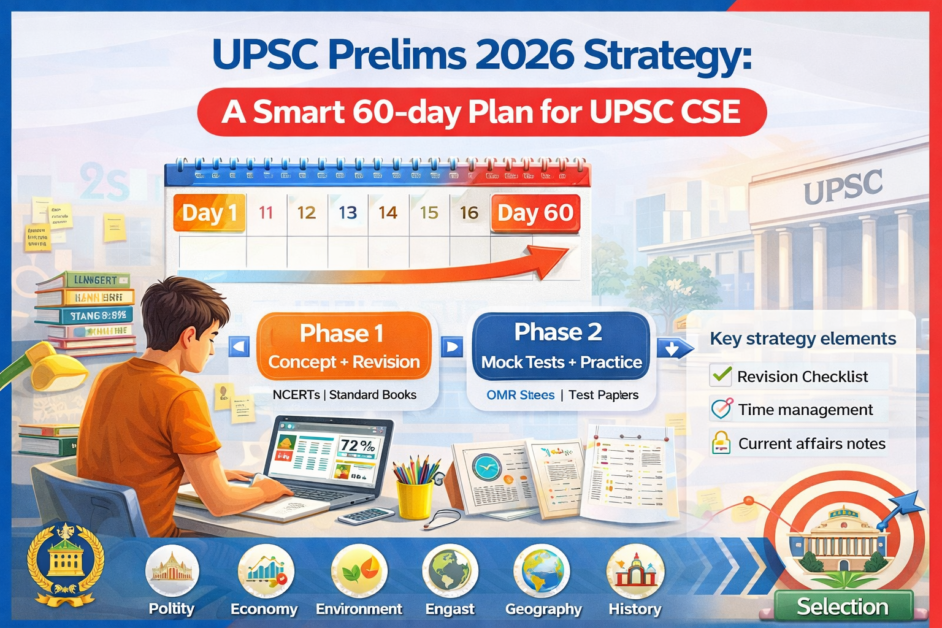
UPSC Prelims 2026 Strategy: A Smart 60-day Plan for UPSC CSE
Preparing for UPSC is an emotion that not only prepares you for one of the toughest exams but also encourages your inner self and brightens your overall personality. UPSC doesn’t look for candidates who are born toppers; it looks for those who are consistent with their approach. One who believes in themselves and is filled with self-confidence can easily sail through this prestigious exam.
The first & foremost stage in this exam is UPSC CSE Prelims, which looks for the analytical ability and filters out a large number of candidates before reaching the UPSC Mains exam. So, opting for a perfect UPSC Prelims 2026 strategy is the key to success.
Civil Services Prelims exams come with two papers:
General Studies Paper I (GS Paper I) — This paper tests your knowledge across subjects like History, Polity, Geography, Economy, Environment, and Current Affairs. It plays a crucial role in determining your selection, as its marks are counted for the Prelims cutoff.
General Studies Paper II (CSAT) — Also known as the Civil Services Aptitude Test, this paper evaluates your comprehension, logical reasoning, and basic numerical ability. It is a qualifying paper, and you need to score a minimum of 33% to clear it.
60-Day Study Plan for UPSC Civil Services Examination Prelims 2026
Choosing the best books for UPSC Prelims is important, but what truly determines your success is how effectively you use your time in the final phase of preparation. Here is the 60-day UPSC Prelims 2026 strategy that can make you crack this prestigious exam:
| Days | Focus Area | Subject / Topics | Daily Practice Targets |
|---|---|---|---|
| Day 1–10 | Core Revision | Polity (Laxmikanth), History (NCERT + UPSC Focus), CSAT Basics (Comprehension, Basic Maths) | 25–30 MCQs (GS) 10–15 CSAT Questions 6–8 Hours Study |
| Day 11–20 | Core Revision | Geography (NCERT + Maps), Economy Basics, CSAT Practice (Reasoning, Quant) | 25–30 MCQs (GS) 15–20 CSAT Questions 6–8 Hours Study |
| Day 21–30 | Practice + Current Affairs | Environment, Current Affairs (Last 1 Year), CSAT Sectional Practice | 40–50 MCQs (GS) 20 CSAT Questions 1 Sectional Test |
| Day 31–40 | Practice + Integration | Mixed Subjects, Revision, CSAT Full-Length Practice | 50+ MCQs (GS) 1 CSAT Sectional / Mock Test |
| Day 41–50 | Mock Tests Phase | Full-Length GS Tests, Weak Areas Focus, CSAT Full-Length Mocks | 1 GS Mock (Every 2 Days) CSAT Mock (Alternate Days) Detailed Analysis |
| Day 51–60 | Final Revision | Short Notes, Important Facts, CSAT Revision (Comprehension + Formulae) | 1 GS Mock (Every 2–3 Days) 1 CSAT Mock Light Revision |
Daily Study Plan To Crack UPSC CSE Prelims 2026
To crack UPSC CSE Prelims 2026, you can opt for the following daily study routine to avoid the last-minute rush:
| Time | Activity | Focus Area |
|---|---|---|
| 6:30 – 7:30 AM | Newspaper Reading | Current Affairs (The Hindu / Indian Express) |
| 7:30 – 8:30 AM | Revision | Revise notes from the previous day |
| 8:30 – 9:30 AM | Breakfast | Enjoy your breakfast |
| 9:30 – 11:30 AM | Core Subject Study | Polity / History / Geography (Concept Building) with NCERT books |
| 11:30 – 12:00 PM | Break | Relax & refresh |
| 12:00 – 1:00 PM | MCQ Practice | Prelims-based questions |
| 1:00 – 2:30 PM | Lunch + Rest | Take proper rest |
| 2:30 – 4:00 PM | Second Subject | Economy / Environment / Science |
| 4:00 – 5:00 PM | Optional Subject | Comprehension / Reasoning / Basic Maths |
| 5:00 – 6:00 PM | Break / Walk | Stay fresh & energized |
| 6:00 – 7:00 PM | Answer Writing | Mixed GS questions or Previous Year Questions |
| 7:00 – 8:00 PM | Dinner Break | Relax and recharge |
| 8:00 – 9:00 PM | Current Affairs Revision | Revise notes / monthly magazine |
| 9:00 – 9:30 PM | Light Revision | Quick revision of key points |
How to Attempt UPSC Prelims 2026 for Maximum Score?
While attempting UPSC Prelims 2026, you need to be wise with the following:
● Begin with strong areas: Start solving those subject questions first, in which you are way more confident, to build exam momentum and save time.
● Adopt the 2-Round strategy: In round 1, attempt easy and direct questions, while in round 2, come back to moderate and tricky ones.
● Avoid Blind Guessing: Negative marking can reduce your score, so attempt only when you can eliminate at least 2 options.
● Adopt the Intelligent Answer-Elimination Technique: Be smart enough to eliminate wrong options, to tick mark the correct one.
● Stay Calm: Difficult questions are common to appear; don’t panic and lose focus.
Pro Tip: Aim for 70-80 questions with 85%+ accuracy, and look for the smart selection rather than shifting your focus to attempting a large number of questions.
How Should You Use Previous Year Questions Effectively for UPSC Prelims 2026?
UPSC Prelims previous year question papers give aspirants direct insight into exam trends, question patterns, and the level of difficulty. However, simply solving UPSC PYQs isn’t enough; you need to use them strategically.
Here’s how to use PYQs effectively:
● Focus on Conceptual Clarity: UPSC often repeats questions. If you practice with the UPSC Previous Year question papers, you’ll get an idea about the frequently asked topics and the exam trend.
● Look for Topic-Wise PYQs first: Practicing through good resources such as Oswaal 31 years UPSC Topic-Wise previous year question banks helps you strengthen your basics in subjects like Polity, History, Geography, etc.
● Move to Full-Length Practice: Once comfortable, start solving PYQs on time to get the habit of real-exam temperament.
● Prepare Notes from PYQs: Maintain a notebook where you can write down important facts, concepts, and tricky questions for quick revision.
● Identify Important Topics: PYQs highlight high-weightage areas that you can prioritize in revisions.
● Revise PYQs multiple times: Repeated revision helps in retaining patterns and improving accuracy.
What Are the Common Mistakes to Avoid in the Last 60 Days of UPSC Preparation?
The last 60 days before UPSC Prelims 2026 are crucial, and even small mistakes during this phase can cost you months of preparation. Here are some common mistakes that you must avoid to crack UPSC Prelims 2026:
● Running Behind New Books or Resources: This is the biggest mistake aspirants make. With multiple YouTube videos or learning resources available, they start exploring, which leads to confusion and wastage of time.
● Ignoring Revision: Jumping to new topics without revising old ones leads to poor retention. Only multiple revisions will sail you through Prelims.
● Not Practicing Previous Year Quetsions (PYQs): Skipping PYQs means missing out on the actual exam pattern and important topics.
● Lack of Mock Test Practice: UPSC IAS Prelims Mock Test is a must to attempt before the final exam, as they help you identify your strengths and weak areas.
● Overloading Current Affairs Resources: Referring to multiple sources for current affairs leads to confusion. So, it’s better to stick to one resource to solve the current affairs in the UPSC Prelims 2026.
Poor Time Management: Spending too much time on one subject or topic can leave other important areas uncovered.
Final Thoughts
Everything is possible if you are consistent with your approach, hold a positive attitude, and are ready to push every limit to make your dreams come true. UPSC is the toughest exam, but it’s not an impossible thing that can’t be achieved.
Timely making UPSC Prelims 2026 strategy, and most importantly, sticking to it, is what matters the most. Simultaneously, keep track of the UPSC previous year question papers to get an idea of the exam trend and high-weightage topics to sail through UPSC, the prestigious exam of the country.
So, what best you can do for yourself is to trust the process, have faith in yourself, and move forward with confidence.
FAQs:
1. Can I clear UPSC Prelims in 60 days?
Absolutely, with consistent practice, proper revision, and mock tests, clearing Prelims in 60 days is achievable.
2. How many mock tests should I attempt?
You should aim for 15–25 full-length mocks with detailed analysis.
3. Should I start new books in the last 60 days?
No, stick to your existing notes and revise them multiple times.
4. How important is current affairs?
Very important—it plays a key role in scoring well in Prelims.
5. What is the most important factor in these 60 days?
Consistency, revision, and smart practice.