
Blog
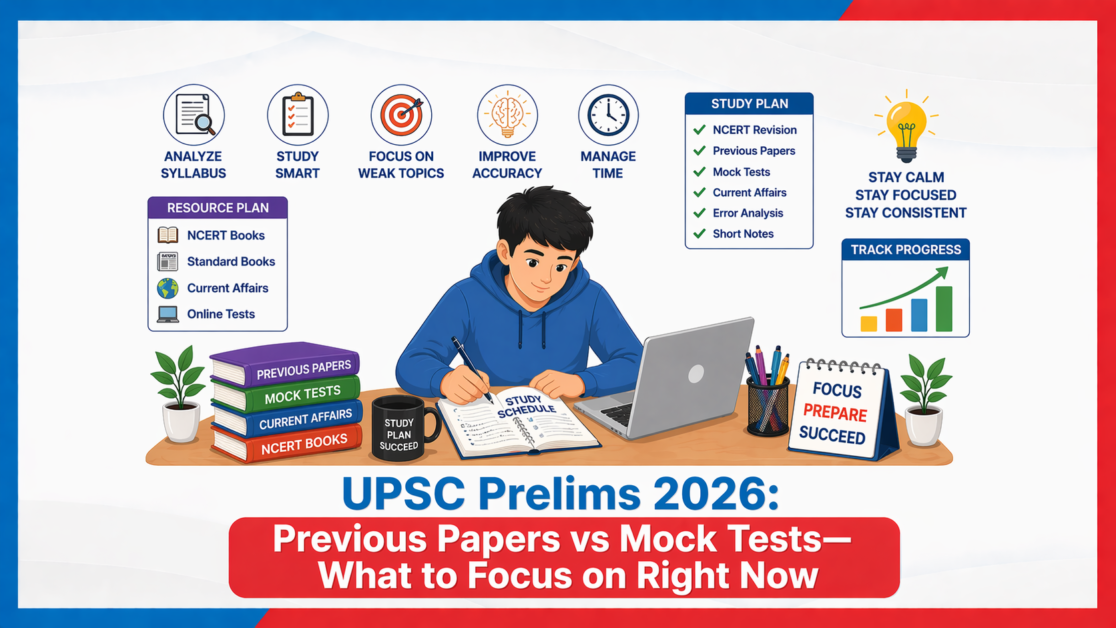
UPSC Prelims 2026: Previous Papers vs Mock Tests
What to Focus on Right Now
You are looking at your study table. On the one side, a pile of PYQs. On the other hand, the mock test series you just signed up for.
Both are important. Both should be a priority. You’re confused about which one you should really be doing right now.
Let me show you how to do this.
The Real Confusion (and Why It Happens)
Each topper’s plan is different. One aspirant swears by working through 20 years’ worth of PYQs. Another aspirant talks about taking more than 50 mock tests. A third aspirant says that mock tests are not that beneficial.
You’re still confused about what suits you.
Here’s what’s going on: they’re all right, but they’re talking about different stages of preparation. If you just started, what worked for someone in their last month won’t work for you.
Knowing what to use and when is the key.
Both previous year papers and mock tests are important. But they have different uses. And if you mix them up at the wrong time, you waste time that you don’t have.
What Previous Year Papers Can Do for You?
Let’s talk about what makes PYQs useful.
You’re not just practicing when you answer a UPSC question from 2015 or 2020. You’re figuring out how UPSC works. You can see what they care about, how they ask questions, and what kinds of choices they use to throw you off.
PYQs show you how things are done. Some topics keep repeating. Some questions repeat again and again. You start to see the pattern even before you finish reading the question if you’ve practiced enough.
PYQs show how UPSC makes difficult choices. You will see that wrong answers are not random. They were made with care. They often have half-truths, facts from other subjects, or information that is no longer true. You get better at getting rid of options once you see this pattern.
Use UPSC previous year question papers as your source of truth. They show you how exam looks like.
What Mock Tests Can Do for You?
UPSC Mock tests are different. They make you feel stressed. They make you make choices right away. They show you what happens when you’re tired, confused, or short on time.
Mocks prepare you for the exam. They show you how to handle 100 questions in two hours. They show you how you guess, the silly mistakes you make, and the areas where you thought you were strong but really weren’t.
More importantly, they help you practise the most important skill for test day: moving on.
You learn how to skip a question that doesn’t make sense in a mock test without wasting five minutes on it. When two choices seem equally good, you learn to trust your gut. You learn to stay calm when the first ten questions are harder than you thought they would be.
You can think of mock tests as a place to practise. They get you ready to do your job in real life
Key Difference Between PYQs & Mock Tests
The easiest way to get this is:
Previous year question papers prepare you for the exam.
Mock tests improve your performance.
One builds up knowledge. The other builds execution.
You can’t skip either one. But you can’t give both things the same amount of attention at the same time. The balance depends on how far along you are in your preparation.
What You Should Be Doing Right Now?
If You Just Started Preparation
Start with the previous year’s question papers from last year.
Work on them by topic. Take out all the Modern History questions from the last 10 to 15 years if you’re studying it. After you’ve read that topic, work on it.
This does two things. It shows you what UPSC wants you to know about that topic. And it helps you remember what you just learned.
Don’t worry about deadlines right now. Pay attention to why the right answer is right and why the wrong ones are wrong. This makes things clearer in your mind.
You can wait for mocks. If you take them now, they’ll just give you too many gaps that you already know about.
If You’re in the Middle Stage
This is where you start to mix the two.
You should still be focused on learning, but you should also start testing yourself on a regular basis.
A good mix UPSC study plan 2026: 70% learning from past papers and 30% testing with mock tests.
Do one mock test every 10 to 15 days. No more. Use it to find your weak spots, then go back and study those spots. Before you take another mock test, make sure you’ve worked on what the last one showed you.
At this point, mocks are used to find problems. They tell you what to study and when.
If You’re Close to Prelims
The scales are now tipping.
You should take practice tests at least two or three times a week in the last month.
But here’s where most people go wrong: it’s not about how many mocks you take. It’s about how deeply you think about each one.
After every mock, spend at least an hour with it. Look at each question you got wrong. Go over the questions you got right. Figure out why you messed up.
At this point, go back and look over the papers from last year to quickly review. They help you stay in touch with the real exam’s style while you practise with mock exams.
How to Use PYQs & Mock Tests at the Same Time
The best way to do this is to make a loop:
Solve previous papers → Identify weak areas → Study concepts → Attempt mock → Analyze deeply → Repeat
Let’s say you figure out Questions about politics from the last ten years. You realise that you don’t know much about Constitutional Bodies. You go back and study that part carefully. Then you take a mock test. You do better in Polity, but you find that you’re not so good at Environment. You study the environment. Do another mock. And so on.
This is where real change happens. You’re not just getting scores on practice tests. You’re using both tools to get rid of weaknesses in a planned way.
Common Mistakes Aspirants Make with PYQs & Mock Test
- Don’t forget about the previous year papers. Some people go straight to mocks because they seem more real. But if you don’t know how UPSC asks questions, you’re just guessing in a structured way.
- Don’t do too many mocks without analyzing them. Trying 10 mocks in a week sounds like a good idea. No, it’s not. If you don’t take the time to learn from your mistakes, you’ll just keep making them.
- Don’t think of mock scores as the last word. Getting a 70 on one mock and an 85 on another doesn’t mean you’re not consistent. Some mocks are harder than others. The most important thing is that you learn from each try.
- Don’t forget to go back and look at your mistakes. This is the most important and hardest part. It’s hard to sit with your mistakes. But that discomfort is where growth happens.
Where Structured Resources Can Help?
Oswaal’s UPSC previous year compilations and other similar books can help you save time here. You don’t have to search through different sources for questions; instead, you get chapter-wise questions from the previous year sorted by topic.
This makes it easier to learn a concept and then do related PYQs right away. It keeps your planning organised without making things more complicated than they need to be.
The goal isn’t to get resources. It’s to use a few well-organised ones smartly.
FAQs
How many years of UPSC PYQs should I go over?
It takes at least 10 to 15 years to really understand patterns and trends.
How many mock tests should I take during UPSC Prelims 2026 preparation?
About 30 to 40 well-analyzed-out mocks. More important than how much analysis is done is how good it is.
Do scores on mock tests show how well someone will do in real life?
Not all the time. They help you get better, but they don’t tell you what your final result will be. Don’t worry about getting a good grade; just learn.
Can I use only the PYQs for the UPSC Prelims?
No, PYQs help you understand trends, but mocks help you get faster, more accurate, and more relaxed during the test.
Conclusion
You don’t have to pick between PYQs and Mock Tests.
You just have to use them at the right time.
In the beginning, Oswaal PYQs show you what the test is worth. In the middle, Oswaal mocks help you see how you’re doing. Mocks help you learn how to perform under pressure, while previous papers help you get a feel for what the real exam will be like.
Both are important. You have to do both. But as you get ready, the balance between them changes.
So stop thinking about which one to pay attention to. Think about where you are in your preparation. And use the right tool for that step.