
Blog
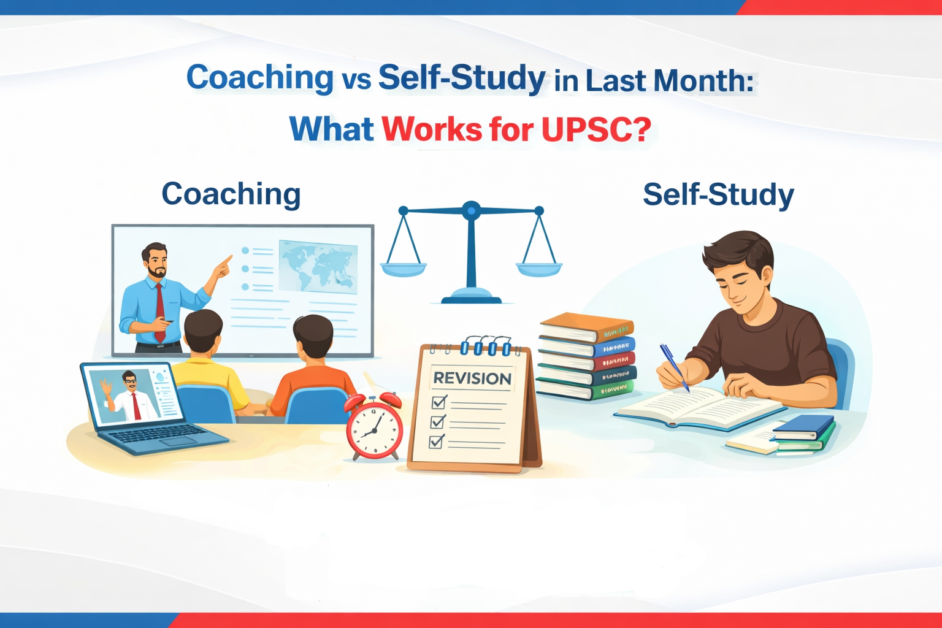
Coaching vs Self-Study in Last Month: What Works for UPSC?
Coaching vs self-study in the last month before UPSC Prelims–this is one of the most Googled UPSC strategy questions every April and May. The straightforward answer to this: neither approach alone wins. The toppers who make it through Prelims in their first attempt follow a hybrid model–coaching mocks for benchmarking, self-study for revision.
The UPSC Prelims is the stage where a large number of candidates are filtered out initially. This could be understood well by looking at the stats. Nearly 5 Lakh aspirants sit for the Prelims every year, out of which only 0.2% make it through this prestigious exam. What separates that 0.2% from the rest is less about syllabus coverage; most serious aspirants have covered the syllabus well. What sets them apart is what they did in the last 30 days, which is the crucial phase of the UPSC preparation.
Studies of topper interviews and optional strategy blogs consistently show that aspirants who had a clear, structured plan for the final month, knowing exactly when to attend coaching and when to sit alone with their notes, outperformed those who either blindly followed their institute’s schedule or isolated themselves completely in self-study mode.
In this informational guide, we break down what coaching and self-study each offer in the final stretch, which approach toppers actually followed, and how to create a perfect UPSC study plan 30 days that pushes you to give your best shot at clearing Prelims.
What does “last month” actually mean for UPSC Prelims?
The last month, roughly 30 days before Prelims, is the time when most of your UPSC syllabus needs to be covered wholly. At this crucial stage, your job is not to learn new topics; instead, look for the three things that matter most—revision quality, mock test analysis, and mental stamina.
Whether you rely on coaching or self-study in this phase depends heavily on your preparation level, learning style, and how well your coaching institute’s test series aligns with your weaknesses.
Coaching in the last month: what it offers
Major reputed coaching institutes run intensive Prelims test series in the final month. Here is what attending coaching in this phase provides:
- Sticking to the structured daily and weekly test schedule helps you remain focused with your learning approach
- Peer benchmarking, where you may know where exactly you stand against the thousands of applicants fighting for the same competition
- Faculty-led analysis sessions after each UPSC mock test help you identify your weak and core strength areas
- Last-minute current affairs capsules and printed compilations are good for revising things quickly at the last moment
Where coaching fails in the last month
Referring to the UPSC prelims last month tips from your selected coaching institutes, there are some pitfalls which you can’t ignore:
- One-size-fits-all approach, your weak areas may not be the batch’s weak areas
- Time lost in commute and attendance, like 2-3 hours per day, is invested
- Over-reliance on coaching notes instead of trusting your own revision material
New topics introduced at the last minute will not add any benefit; instead, cause harm to your UPSC preparation strategy 2026.
Self-Study in the last month: what it offers
Self-study in the final month can work wonders. Your UPSC revision strategy must include revision of your own prepared notes, attempting online mocks, and spending time exactly where you need it. Many UPSC toppers, including IAS 2025 AIR 1 Anuj Agnihotri, have spoken about the importance of self-directed revision in the final weeks.
- 100% time efficiency, as no time will be wasted in commuting, and following the coaching institute’s schedules
- Faster retention by revising your own notes, and that too at your own pace
- Flexible mock schedule where you can sit for the tests when you are fully prepared, not when the batch demands
Deeper analysis of mistakes without time pressure from group sessions
Where self-study fails in the last month
Self-study sounds ideal on paper: flexible schedule, full control, and preparation from one’s own notes. But for the significant number of aspirants, self-study without external checks creates blind spots that are almost impossible to catch on your own. Here is where it tends to break down:
- Isolation and low motivation without peer accountability
- No external benchmark, as you aren’t aware of whether your score is competitive
- Current affairs are hard to cover, as most of the time get wasted in looking for reliable resources
- Leniency in following the study schedule, as there is no pressure to stick to it, while in coaching, there is
Comparison of Coaching vs Self-Study in the last 30 days
| Parameter | Coaching | Self-Study |
|---|---|---|
| Time Efficiency | Lower (commute + batch timings) | Higher |
| Peer Benchmarking | Strong (1000s of students) | Weak (self-assessment only) |
| Revision Quality | Generic, with batch-level material | High with one’s own prepared notes |
| Mock Test Quality | Coaching institutes create exam-level mocks that could be advanced | Depends on the platforms used |
| Current Affairs | Ready-made capsules & compilations | Self-compiled or online sources |
| Motivation | Competition between batchmates keeps you going | A highly disciplined approach is required |
| Flexibility | Fixed and rigid study schedule | Full flexibility, might become lenient at times |
| Cost | High (₹5000–₹20000 for test series) | Low or free platforms available |
Which approach is right for you to crack UPSC 2026 Prelims?
There is no right or wrong approach to be followed in the last month of the UPSC preparation 2026. What works well for one doesn’t work well for others, so there is no universal answer to this. At this point, the suitable path to be followed depends entirely on three things: where you are in your preparation, how disciplined you are without external accountability, and how well your current mock scores reflect your actual readiness.
To make this more practical, here is a simple framework based on what has worked for aspirants who cleared Prelims:
Choose Coaching-Led Preparation If:
You are appearing for UPSC Prelims for the first time
- Do not have a reliable self-study system
- Mock test scores fluctuate, good in the first week and dropping sharply the next week
- Lagging with a strong current affairs revision habit
- Can’t remain disciplined throughout the learning process
If there is a tick mark on any of the above pointers, then opting for the coaching test series in the last month of UPSC preparation is the safe option.
Choose Self-Study If:
You have prepared for the Prelims at least once before
- Good at making subject notes & revision summaries
- Mock scores are stable and above the expected cutoff range
- Consistent in following the study routine once prepared
Self-study gives you more return per hour than sitting through batch-level sessions designed for the average aspirant, not for your specific gaps.
Choose the Hybrid Model If:
You want the discipline of the coaching side-by-side following your self-study routine
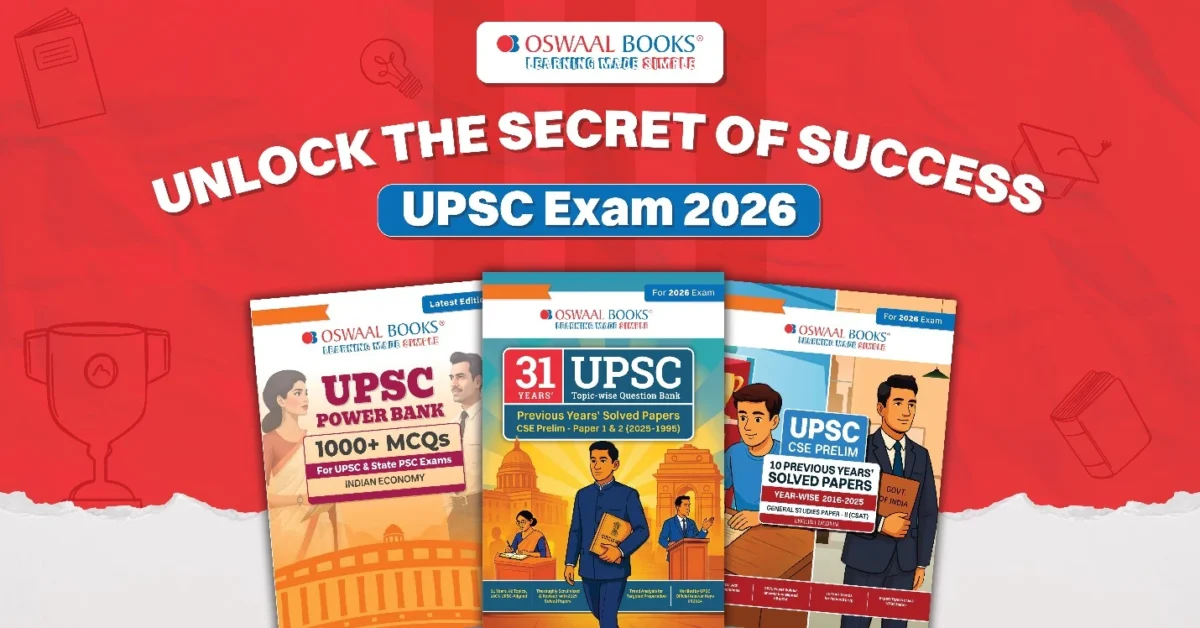
- Comfortable solving 2 to 3 full mocks per week from Oswaal UPSC CSE Prelim 15 Mock Test Papers
- Good at managing revision and weak-area work regularly
- You know how to prepare current affairs independently at home
The hybrid approach is the most sought-after and most followed by the aspirants who clear Prelims on their first or second attempt.
Topper-Inspired 4-Week Plan for the Last Month
| Week | Focus Area | What to Do Daily | Mock Tests |
|---|---|---|---|
| Week 1 | Full Syllabus Revision (Round 1) | Revise 2–3 subjects daily (Polity, History, Geography, Economy) + 50 MCQs | 2 Full-Length Tests |
| Week 2 | Weak Areas + Practice | Focus on weak subjects + revise current affairs + 75–100 MCQs daily | 2–3 Full-Length Tests |
| Week 3 | Intensive Testing + Revision | Mixed revision + daily CSAT practice (1–2 hrs) + PYQs | 3–4 Full-Length Tests |
| Week 4 | Final Revision + Light Practice | Only short notes, facts, formulas + limited MCQs (50 per day) | 2–3 Light Tests |
How Oswaal UPSC Preparation Books Help You Crack the Prelims
Oswaal series of UPSC preparation books includes UPSC Mock Test Papers Prelims set of 2 (Paper 1 & CSAT), 31 years UPSC Topic-wise Question Bank Previous Years Solved Papers CSE Prelim -Paper 1 & 2, UPSC Power Bank with 400+ & 1000+ MCQs, UPSC NCERT books. They are loaded with the following extensive features to make your preparation more structured and exam-focused:
- Exam-Focused & Syllabus-Aligned Mock Papers: Covers a full-length UPSC Prelims mock test set of 2 (Paper 1 & CSAT), strictly mapped to the latest UPSC Prelims syllabus.
- Coverage of both GS Paper 1 & CSAT: Oswaal UPSC mock test papers 2026 prelims allows the aspirants to prepare both papers in parallel. Special emphasis is given to CSAT Paper 2, covering comprehension, logical reasoning, quantitative aptitude, and decision making.
- Trend Analysis & Expert Tips: Each mock test is trend analysed from previous years’ question papers, helping students focus on high-weightage & frequently asked topics.
- Detailed & Concept-Based Solutions: Oswaal UPSC books 2026 come with well-explained, step-by-step solutions, helping learners to clear the Prelims cut-off.
- Over 1400+ Subject-Wise & Topic-Wise MCQs: All the PYQs in the Oswaal question bank for UPSC encourage focused preparation of Polity, History, Geography, Economy, Science & Technology, Current Affairs, and CSAT.
Final Thoughts
The last month before UPSC Prelims works best when moved forward with a hybrid approach–coaching for mock benchmarking, self-study for all revision and weak area work. One of the best UPSC time management tips in this phase could be to protect your peak hours, cap mock analysis at 75 minutes, and follow revision, mocks, and current affairs. Along with the core subjects like History, Geography, Polity, etc., daily practice for the CSAT paper all through the four weeks will definitely make a difference. With Oswaal UPSC preparation books, you can get access to syllabus-aligned mock test papers, over 1400+ MCQs, expert tips, trend analysis, and more. These features will boost your confidence and take your preparation to the next level.
Disappear for a while, work like crazy, & come back with a rank, that is all we wish for!
FAQs:
- Is coaching necessary in the last month before UPSC Prelims?
No, coaching is not necessary in the last month. If you have strong self-study notes and a reliable mock test platform, self-study can be equally or more effective.
- How many mocks should I give in the last month before UPSC Prelims?
Most toppers recommend 8–12 full-length mocks in the last 30 days, roughly 2–3 per week.
- Should I join a test series if I have been self-studying for UPSC?
Yes, even for self-study aspirants, joining a reputed test series in the last month is advisable.
- Can self-study students clear UPSC Prelims without coaching?
Absolutely. Many UPSC toppers, including recent AIR 1 holders, have cleared Prelims and Mains through self-study. The key factors are quality source material, consistent mocks, deep analysis, and disciplined revision, not coaching attendance.