
Blog
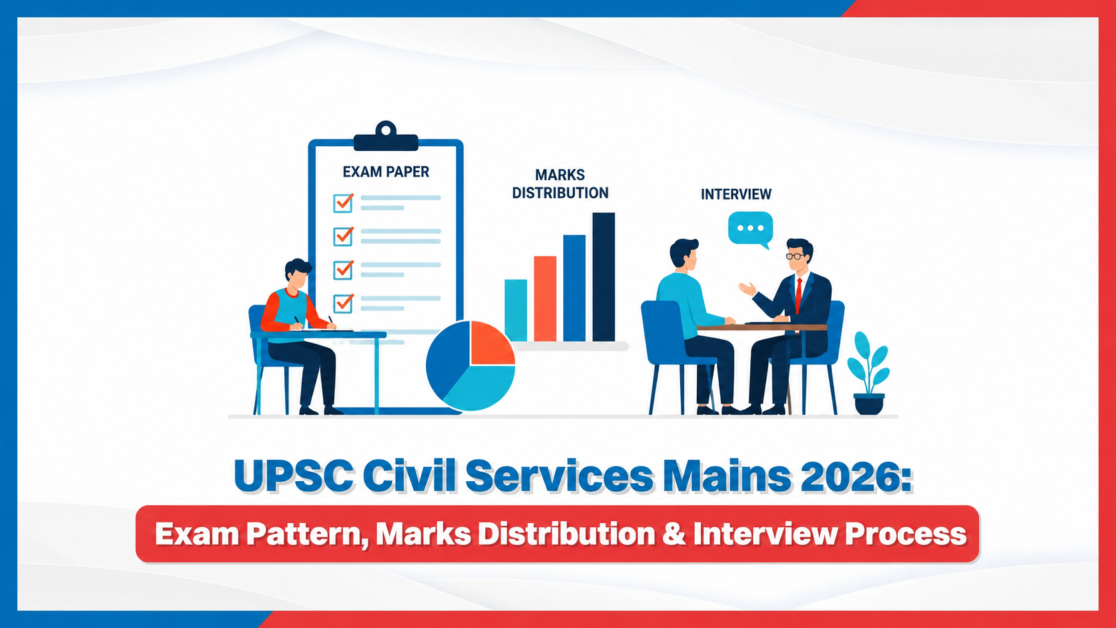
UPSC Civil Services Mains 2026:
Exam Pattern, Marks Distribution & Interview Process
Out of the three-stage selection process, UPSC Mains 2026 is the second and most crucial phase. Conducted by the Union Public Service Commission, it looks for aspirants who clear the Preliminary examination (Prelims) and are set to write knowledge-driven Mains answers. After the release of the official notification, it is held around September-October of the exam year. Combined with a Personality Test (Interview), the Mains stage ultimately determines your rank in the final merit list for services like IAS, IPS, IFS, IRS, and others.
As it plays a crucial role in deciding the rank, it is necessary to have a better understanding of the UPSC exam pattern, marks distribution, and finally the interview process. In this informational segment, let’s have a look at each & every aspect of this stage of the exam.
UPSC Mains Exam Pattern 2026
| Paper | Subject | Marks | Duration | Nature |
|---|---|---|---|---|
| Paper A | Indian Language (Compulsory) | 300 | 3 hrs | Qualifying |
| Paper B | English (Compulsory) | 300 | 3 hrs | Qualifying |
| Paper I | Essay | 250 | 3 hrs | Merit |
| Paper II | GS I – History, Geography, Society | 250 | 3 hrs | Merit |
| Paper III | GS II – Governance, Polity, IR | 250 | 3 hrs | Merit |
| Paper IV | GS III – Economy, Environment, S&T | 250 | 3 hrs | Merit |
| Paper V | GS IV – Ethics, Integrity & Aptitude | 250 | 3 hrs | Merit |
| Paper VI | Optional Subject – Paper 1 | 250 | 3 hrs | Merit |
| Paper VII | Optional Subject – Paper 2 | 250 | 3 hrs | Merit |
UPSC Marks Distribution (Mains + Interview)
| Component | Marks | % of Total |
|---|---|---|
| Essay (Paper I) | 250 | 12.3% |
| GS Papers I to IV | 1000 | 49.4% |
| Optional Papers (I + II) | 500 | 24.7% |
| Personality Test (Interview) | 275 | 13.6% |
| Total | 2025 | 100% |
UPSC Interview Process (Personality Test)
Candidates who pass the Mains written examination are called for the UPSC Personality Test, popularly called the UPSC Interview. It is of 275 marks and is arranged by a board of UPSC members at UPSC Bhawan, New Delhi. The interview typically lasts 20-45 minutes, and there is no fixed syllabus which you can prepare for and sit in front of the board members. UPSC Interview process includes some steps which you need to keep in mind:
Step 1- Document Verification
Candidates are required to keep ready original certificates, DAF (Detailed Application Form) submitted during Mains, and other identity documents.
Step 2- DAF-Based Q&A
You can expect most of the interview questions based on your educational background, hometown, hobbies, and work experience, which you have mentioned in your DAF.
Step 3- Current Affairs & Opinion
You will be tested on national and international current events, governance issues, environmental reports, and your views on policy matters.
What are the best UPSC Mains Exam books 2026?
UPSC Prelims and UPSC Mains demands way different approach, in terms of strategy, concept clarity, answer writing and analytical thinking. To crack the Mains exam, you can rely on resources such as Oswaal that include:
Updated Syllabus-Aligned Content: Includes Mains PYQs from 2013 to the latest available year, aligned with the official UPSC GS Paper II syllabus, to help students focus on high-weightage topics.
- Smart Revision Tips: Quickly revise with the help of keywords, quotes, and examples designed for last-minute preparation.
- In-depth Coverage of GS Papers I-IV: Oswaal UPSC Mains previous year question papers include fully solved papers of GS papers I-IV, to help aspirants grasp question trends and improve answer writing.
- Expert Tips to Write High-Scoring Mains Answers: Oswaal UPSC Mains PYQ book includes expert guidance on demand analysis, keyword usage, and presentation techniques that can improve Mains score.
- Toppers’ Written Essays: Toppers’ written answers will help aspirants get an idea of how to write high-scoring essays.
Updated NCERT Coverage: Oswaal UPSC Mains exam books series includes NCERT One For All with new chapters and changes from the latest NCERT editions, ensuring complete syllabus coverage.
Concluding Words
Sailing through the UPSC journey requires passion, determination, and a strategic approach. For the Mains, aspirants must go through the UPSC previous year question papers of good resources such as Oswaal to better understand the exam pattern, high-weightage questions, repeated topics, and the evolving nature of questions. On the other hand, to excel in the UPSC Personality Test, practice mock interviews with senior aspirants or good coaching institutes at least 3-4 weeks before the actual interview date. To look sharp during interaction with the board members, read a quality newspaper daily, be it The Hindi, Indian Express, or more.
More than preparation, it is the positive attitude and consistent approach that can make you win this exam. Keep moving and live by the simple principle—Fake it until you make it, because the UPSC journey will test you in every possible way. But once standing upright, deny to give up, you can actually achieve what you have dreamt of.
FAQs
Q1. When is UPSC Mains 2026 conducted?
UPSC Mains is typically held around September–October of the exam year, after the release of Prelims results. Candidates should regularly check upsc.gov.in for the official schedule.
Q2. How many papers are there in UPSC Mains 2026?
There are 9 papers in total — 2 qualifying papers (English & Indian Language) and 7 merit papers including Essay, GS I–IV, and Optional Paper I & II.
Q3. What is the total marks for UPSC Mains 2026?
The written Mains carries 1750 marks. Adding the 275-mark Personality Test, the grand total comes to 2025 marks.
Q4. Are UPSC Mains papers descriptive or objective?
All Mains papers are purely descriptive — no MCQs. Answers are written in long form, making answer-writing practice a core part of preparation.
Q5. How long does the UPSC Interview last?
The interview typically lasts between 20 to 45 minutes and is conducted at UPSC Bhawan, New Delhi, by a board of senior UPSC members.