
Blog
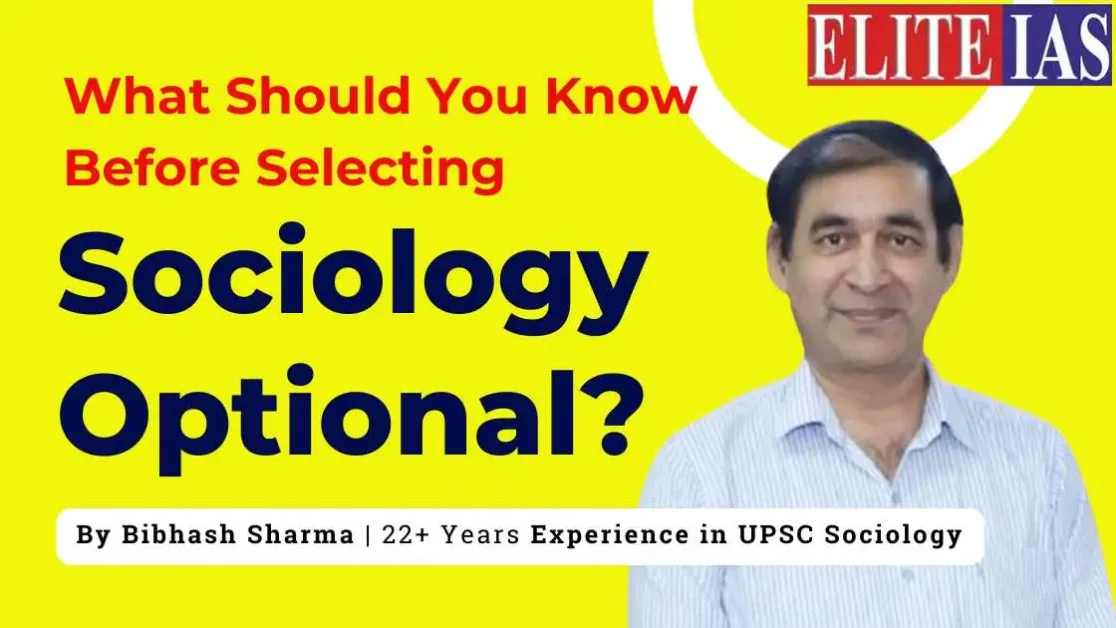
What Should You Know Before Selecting Sociology Optional?
Choosing an optional subject is one of the most important decisions in the UPSC Civil Services Examination. While General Studies is common for all candidates, the optional subject often becomes the decisive factor that separates a rank holder from the rest of the competition. Many aspirants spend months debating whether they should choose Sociology, Political Science, Geography, History, or Public Administration. However, the right approach is not to follow trends but to understand what a subject demands and whether it aligns with your interests and strengths.
Among the various optional subjects, Sociology has consistently remained one of the most popular choices. Its concise syllabus, overlap with General Studies, relevance to current affairs, and applicability in the Essay paper make it attractive to aspirants from diverse academic backgrounds. Yet, before selecting Sociology Optional, there are several factors that every UPSC candidate must carefully evaluate.
Why Sociology Optional Has Become One of the Most Preferred UPSC Optionals
The popularity of Sociology Optional is not merely the result of market perception. It is rooted in practical advantages that directly benefit UPSC aspirants.
One of the biggest reasons is the relatively manageable syllabus compared to many other optionals. Aspirants can complete the core syllabus within a reasonable timeframe and devote more energy to revision, answer writing, and General Studies preparation.
Another major advantage is the extensive overlap with General Studies. Topics such as caste, social justice, women empowerment, poverty, globalization, urbanization, education, social movements, and governance frequently appear in GS Papers I, II, and III. This overlap creates preparation efficiency and reduces duplication of effort.
Sociology also contributes significantly to Essay preparation. UPSC increasingly asks essays related to society, development, ethics, technology, social change, and governance. Candidates with a sociological perspective often find it easier to develop multidimensional arguments supported by contemporary examples.
Beyond the examination, Sociology helps aspirants understand society itself. Civil servants work with communities, institutions, vulnerable groups, and development challenges. Sociology develops a deeper understanding of human behaviour, social institutions, inequality, culture, and social transformation, making it relevant not only for UPSC but also for public service.
Understanding the Sociology Optional Syllabus Before Making a Decision
Aspirants often choose an optional subject based on recommendations from seniors, coaching institutes, or toppers. However, the most reliable way to evaluate any optional is by carefully examining its syllabus.
The sociology optional syllabus is divided into two papers, each serving a distinct purpose.
Paper I: Building the Sociological Foundation
Paper I introduces Sociology as an academic discipline and focuses on core sociological theories and concepts. It covers themes such as sociological thinkers, social stratification, social institutions, social change, culture, religion, family, kinship, and social control.
A major portion of this paper revolves around understanding classical thinkers such as Karl Marx, Max Weber, Emile Durkheim, Talcott Parsons, and Robert K. Merton. These thinkers provide analytical frameworks that can be applied to a wide range of contemporary social issues.
The objective of Paper I is not merely to learn theories but to develop a sociological perspective towards understanding society.
Paper II: Understanding Indian Society
Paper II applies sociological concepts to the Indian context. It explores caste, tribe, family, religion, regionalism, social movements, agrarian structure, industrialization, urbanization, and social change in India.
This paper often attracts aspirants because many topics overlap with current affairs and General Studies. Issues such as gender inequality, migration, digital transformation, rural distress, social justice, and identity politics can be analysed using concepts from the syllabus.
Unlike technical subjects that require extensive factual memorization, the sociology optional syllabus emphasizes conceptual understanding, interpretation, and application. This characteristic makes the subject particularly attractive to aspirants who enjoy analytical thinking.
A Self-Assessment Framework Before Choosing Sociology Optional
Before selecting Sociology, every aspirant should honestly evaluate whether the subject matches their interests and aptitude.
The first question to ask is whether you genuinely enjoy reading about society and social issues. Sociology is fundamentally about understanding social structures, institutions, inequalities, identities, and social change. If these topics naturally interest you, the subject may become easier to sustain over a long preparation cycle.
Second, consider whether you enjoy analytical writing. Sociology is not a fact-heavy subject where information alone guarantees marks. Success requires interpretation, evaluation, and sociological analysis.
Third, assess your ability to connect theories with real-world developments. High-scoring Sociology answers often integrate classical thinkers with contemporary examples such as social media activism, migration trends, artificial intelligence, urbanization, and changing family structures.
Another important consideration is your learning style. Candidates who prefer conceptual learning generally perform better in Sociology than those who rely solely on rote memorization.
Finally, ask yourself whether you can consistently engage with newspapers, social issues, and current affairs. Sociology rewards aspirants who remain intellectually curious about developments occurring around them.
Can Sociology Optional Help You Score 300+ Marks?
A common misconception among aspirants is that certain optional subjects automatically guarantee high marks. Sociology is often included in this category. The reality is more nuanced.
Sociology certainly offers the potential for high scores, but achieving 300+ marks depends on preparation quality rather than subject selection alone.
High-scoring candidates distinguish themselves through strong answer writing, effective thinker application, and sophisticated sociological analysis. They do not merely define concepts; they explain social phenomena through theoretical frameworks and support their arguments with contemporary examples.
For instance, a discussion on digital inequality becomes significantly richer when linked to social stratification, globalization, and technological access. Similarly, questions on social movements become more analytical when examined through theories proposed by Marx, Weber, or Merton.
The ability to think sociologically rather than descriptively is what ultimately creates scoring opportunities in the examination.
Why Guidance and Mentorship Matter in Sociology Optional
Many aspirants underestimate the complexity of Sociology because the syllabus appears concise. However, the challenge lies not in completing the syllabus but in mastering its application.
Common mistakes include excessive dependence on notes, superficial understanding of thinkers, inadequate answer-writing practice, and failure to integrate current affairs into answers.
This is where mentorship becomes valuable. Students often benefit from structured sociology optional coaching that helps them develop sociological thinking and answer-writing skills. Proper guidance can significantly reduce trial-and-error learning and help aspirants understand examiner expectations.
Elite IAS offers Sociology Optional under the mentorship of Bibhash Sharma.
With more than two decades of teaching experience, Bibhash Sharma has guided thousands of aspirants in developing conceptual clarity, analytical thinking, and examination-oriented answer-writing techniques.
Why a Sociology Optional Test Series Is Essential
Many aspirants complete the syllabus but fail to translate knowledge into marks because they neglect answer writing. UPSC rewards presentation, structure, and analytical depth as much as knowledge itself.
A quality sociology optional test series helps aspirants identify weaknesses and improve answer presentation before the UPSC examination.
Regular testing develops time management, strengthens conceptual retention, improves thinker application, and familiarizes candidates with examination pressure. It also provides opportunities for expert evaluation and continuous feedback, which are critical for improvement.
Candidates who consistently participate in a well-designed test series often gain a significant advantage in the Mains examination.
Who Should Choose Sociology Optional?
Sociology can be an excellent choice for humanities students because of its conceptual overlap with other social sciences. However, the subject is equally suitable for engineering graduates, medical professionals, working professionals, and fresh graduates.
The subject does not require prior academic specialization. What matters more is intellectual curiosity, analytical thinking, and a willingness to understand society through a sociological lens.
Conclusion
Selecting an optional subject should never be based solely on popularity, trends, or recommendations. Sociology offers several advantages, including a manageable syllabus, overlap with General Studies, relevance to current affairs, and strong scoring potential. However, it also demands conceptual clarity, answer-writing ability, thinker application, and consistent practice.
If you are genuinely interested in understanding society, social institutions, inequality, culture, globalization, and contemporary social challenges, Sociology can become one of the most rewarding optional subjects for UPSC preparation.
Before making your final decision, carefully study the syllabus, read a few standard Sociology chapters, examine previous-year questions, and evaluate your genuine interest in the subject. A well-informed choice today can significantly influence your performance in the Civil Services Examination and your journey toward becoming a successful civil servant.
Author: Bibhash Sharma
(Senior Sociology Mentor | Elite IAS)
This article is written by Bibhash Sharma, a senior Sociology mentor with 22+ years of experience in UPSC preparation. He specialise in UPSC Sociology Optional. Known for his scientific teaching methodology and result-oriented approach, he has consistently guided aspirants to score 300+ marks in Sociology. His expertise lies in simplifying complex thinkers like Durkheim, Weber, and Marx into structured, exam-ready frameworks.
Through his mentorship at Elite IAS, he has helped hundreds of students build strong conceptual clarity, answer-writing skills, and rank-winning strategies in UPSC CSE.
👉 Explore more about Bibhash Sharma Sociology Optional Classes and Sociology Optional Test Series at Elite IAS.