
Blog
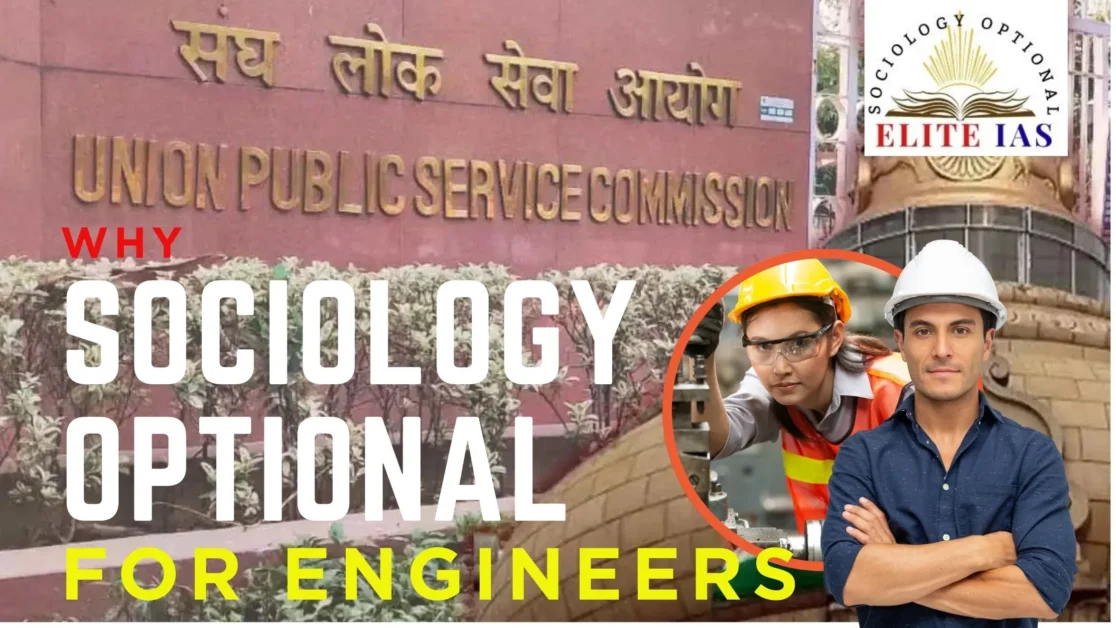
Sociology Optional for Engineers: A Strategic Advantage in UPSC CSE
A striking feature of the UPSC Civil Services Examination over the last two decades has been the dominance of engineering graduates among serious aspirants. This is not incidental. Engineering education cultivates analytical discipline, comfort with abstraction, and a problem-solving orientation – traits that align well with the demands of a multi-layered competitive examination like UPSC CSE.
However, when it comes to selecting an optional subject, engineers often face a strategic dilemma: whether to continue with a technical optional closely tied to their graduation discipline or to shift to a humanities subject that offers broader integration with General Studies. Within this context, Sociology Optional has emerged as a rational and structurally compatible choice.
Sociology appeals to engineers not because it is “easy,” but because it is system-oriented, logically organized, and conceptually bounded. Over years of mentoring civil services aspirants, figures such as Bibhash Sharma at Elite IAS have observed a consistent pattern: engineers who approach Sociology with methodological discipline tend to adapt quickly to its conceptual vocabulary and evaluative demands. The subject rewards structured thinking, clarity of argument, and the ability to link theory with empirical reality – capacities already familiar to those trained in technical fields. As a result, Sociology Optional has increasingly been viewed as a strategic bridge between analytical rigor and interpretive depth within the UPSC framework.
Why Engineers Gravitate Toward Sociology Optional
The engineering mindset is fundamentally shaped by systems thinking. Engineers are trained to deconstruct complex phenomena into components, identify causal relationships, and work within models that explain how variables interact. Sociology, despite dealing with social rather than mechanical systems, operates in a surprisingly similar manner. Core sociological theories – functionalism, conflict theory, symbolic interactionism – are essentially explanatory models that seek to make sense of patterned social behaviour.
For engineers, abstract sociological concepts such as social stratification, power, or institutionalization do not remain vague ideas for long. They are quickly converted into structured variables that can be analysed across contexts. For instance, social stratification can be examined through dimensions like class, caste, gender, and occupation, much like parameters in an engineering model. This structural clarity allows engineers to move beyond surface-level descriptions and engage with sociology analytically rather than memoratively.
Another reason sociology resonates with engineers is its evaluative orientation. Sociology answers are assessed not on the volume of information reproduced, but on conceptual clarity, logical coherence, and relevance to the question asked. This mirrors the problem-solving ethos of engineering examinations, where precision matters more than verbosity. Consequently, sociology tends to reward clarity over rote learning, making it particularly suitable for candidates accustomed to disciplined thinking.
Syllabus Structure and Cognitive Fit for Engineers
From a learning-design perspective, the Sociology Optional syllabus is compact and internally coherent. Paper I focuses on foundational concepts, thinkers, and theoretical frameworks. It introduces aspirants to classical sociologists such as Durkheim, Weber, and Marx, along with contemporary perspectives. For engineers, this paper functions much like a core theory module, where understanding first principles is essential before application.
Paper II applies these concepts to Indian society. Themes such as caste, religion, family, social movements, and rural-urban dynamics are examined through an empirical lens. The transition from Paper I to Paper II is not abrupt; rather, it mirrors the engineering pedagogy of moving from theory to application. Concepts learned in Paper I recur in Paper II, allowing for conceptual repeatability and reinforcement.
This repeatability significantly enhances revision efficiency. Unlike optionals with sprawling syllabi or fragmented content, sociology allows engineers to revise through thematic consolidation. Once a concept is internalized, it can be deployed across multiple topics and questions. This makes sociology manageable alongside General Studies, especially during the Mains-focused phase of preparation when time becomes a scarce resource.
Preparation Orientation: From Content to Systems
A common initial mistake engineers make is approaching sociology as another content-heavy subject. Effective preparation, however, requires a shift in orientation. A well-designed sociology optional preparation strategy treats the subject as a system rather than a repository of facts. The first step is precise syllabus mapping – breaking down each topic into core concepts, associated thinkers, and possible areas of application.
Concept layering is central to this approach. Foundational ideas are learned first, followed by their theoretical extensions and empirical illustrations. Over time, these layers interact, enabling aspirants to produce nuanced answers without excessive memorization. Iterative revision then consolidates this learning, ensuring that concepts remain accessible under exam conditions.
Engineers, in particular, benefit from avoiding indiscriminate content accumulation. Sociology does not reward the reproduction of extensive notes or quotations. Instead, it values frameworks – structured ways of introducing, analyzing, and concluding answers. By focusing on framework-building, engineers can leverage their natural inclination toward structured problem-solving and apply it effectively within sociological discourse.
Overlap with General Studies, Essay, and Ethics
One of the most compelling reasons engineers opt for sociology is its extensive overlap with General Studies and the Essay paper. Sociological perspectives enrich answers on social justice, governance, welfare policies, and globalization – areas that recur across GS Papers I and II. Concepts such as inequality, marginalization, and social change provide analytical depth that purely factual answers often lack.
In the Ethics paper, sociological insights into values, norms, and socialization help aspirants contextualize ethical dilemmas. Understanding how societal structures influence individual behaviour allows for more balanced and realistic ethical reasoning. Similarly, in essays, sociological thinkers and frameworks offer ready-made lenses through which broad themes can be examined critically.
This integrative advantage reduces cognitive load for engineers. Instead of preparing isolated silos of information, they can draw upon a common conceptual base across multiple papers. As a result, sociology functions not merely as an optional subject but as an intellectual resource that strengthens overall Mains performance.
At this stage of preparation, once conceptual clarity and syllabus control are established, the critical challenge shifts from understanding sociology to expressing it effectively under examination conditions. This transition – from learning to articulation, from content to evaluation – marks the point where answer writing and assessment dynamics begin to play a decisive role.
Engineers who opt for Sociology Optional often discover that the primary challenge is not mastering the syllabus but translating their understanding into sociologically grounded answers. Technical education trains students to arrive at correct solutions through precise methods, often privileging final outcomes over interpretive exposition. In the UPSC Mains examination, however, answers are evaluated less on conclusiveness and more on the reasoning pathway. Sociology demands that candidates demonstrate how they arrive at an argument, situate it within a theoretical framework, and relate it to empirical contexts. This shift – from solution-centric writing to interpretation-centric writing – requires deliberate recalibration.
Why Answer Writing Decides Scores for Engineers
Most engineers are comfortable with content acquisition. They can read standard texts, understand theories, and memorize definitions efficiently. The difficulty arises when this content must be articulated in a manner that reflects sociological sensibility. Early attempts at answer writing often resemble technical explanations: direct, compressed, and insufficiently contextualized. Such answers may be factually accurate yet lack analytical depth.
High scores in Sociology Optional depend on framing. A sociological answer typically moves through three layers: conceptual grounding, analytical expansion, and contextual illustration. Engineers must therefore learn to slow down their exposition – introducing thinkers, explaining concepts, and then applying them to the question. The difference between a 230-range score and a 300+ score is rarely the number of thinkers quoted; it lies in interpretive coherence. Examiners look for the ability to connect ideas logically, acknowledge multiple perspectives, and arrive at balanced conclusions. Information alone does not secure marks; interpretation does.
Evaluation Psychology of UPSC Examiners
UPSC examiners assess sociology answers through a qualitative lens. They are trained to identify sociological depth, not terminological density. Excessive jargon, particularly when unsupported by explanation, is often counterproductive. What evaluators value is the candidate’s ability to demonstrate understanding – how well concepts are explained, how relevant thinkers are integrated, and how arguments are substantiated with appropriate examples.
Balance is central to this evaluation process. A well-written answer typically integrates classical or contemporary thinkers, empirical illustrations from Indian society, and references to current social developments. Overemphasis on any single element – such as theory without application or examples without conceptual grounding – can weaken an answer. Engineers, accustomed to precision, must learn to balance these elements deliberately. Sociology rewards answers that are proportionate, context-aware, and analytically consistent.
Test Series and Feedback Loops
Answer writing competence develops through iterative practice rather than isolated attempts. Test series play a critical role in this process by simulating examination conditions and exposing candidates to evaluative standards. For engineers, this exposure is particularly important because it provides external calibration – an objective measure of how their answers are being interpreted by evaluators.
In the initial stages, test series help identify recurring issues such as inadequate introductions, abrupt conclusions, or insufficient linkage between theory and application. Over time, structured feedback allows aspirants to correct these patterns systematically. By the fourth or fifth evaluative cycle, many candidates begin to internalize examiner expectations, leading to more consistent performance. At this stage, participation in a sociology answer writing test series functions less as assessment and more as refinement, enabling aspirants to align their writing with the nuanced demands of the discipline.
Effective test preparation follows a feedback loop: write, evaluate, revise, and rewrite. This loop reinforces learning and ensures that improvements are cumulative rather than episodic. Engineers, familiar with iterative design and testing processes, often adapt well to this model once its relevance is recognized.
Contextual Explanation of Teaching and Mentorship
Over sustained periods of preparation, certain teaching approaches have demonstrated particular effectiveness for engineers transitioning into sociology. An academically grounded mentorship model emphasizes structured answer frameworks, disciplined evaluation criteria, and consistent sociological framing. Observations from classrooms and test evaluations suggest that when aspirants are trained to think in terms of arguments rather than conclusions, their performance stabilizes.
Within this context, Bibhash Sharma’s work as a sociology mentor illustrates a methodical emphasis on answer-writing methodology and evaluation discipline rather than content expansion. His approach foregrounds how sociological arguments are constructed, assessed, and refined over time. This long-term emphasis has coincided with a visible trend: engineers emerging as consistent high scorers in Sociology Optional over the past seven years. The trend is not attributable to background alone but to the alignment between analytical training and disciplined sociological articulation.
Why Sociology Is Safer for Engineers Than Volatile Optionals
When compared with technical optionals, sociology offers greater moderation stability. Technical subjects are often vulnerable to scaling issues, unpredictable question framing, and narrow evaluative margins. A small conceptual error can significantly affect scores. Sociology, by contrast, allows for partial credit through reasoned argumentation, even when answers are not exhaustive.
Compared to some humanities-heavy optionals, sociology maintains tighter syllabus boundaries and clearer conceptual anchors. Subjects with extensive literary or historical breadth can become unwieldy, particularly for aspirants balancing General Studies alongside optional preparation. Sociology’s predictability, combined with its integrative value across papers, makes it a comparatively safer choice. For engineers seeking syllabus control and evaluative transparency, this stability is a decisive factor.
Access, Structure, and Continuity in Preparation
As preparation increasingly incorporates online modes, aspirants have access to structured guidance regardless of location. The relevance of Sociology Optional Best Coaching Online lies not in branding but in continuity—regular evaluation, structured feedback, and sustained mentorship. For engineers, continuity ensures that conceptual understanding and answer-writing skills evolve in parallel rather than in isolation. A structured environment reduces uncertainty and allows aspirants to focus on disciplined execution.
To conclude, Sociology Optional aligns naturally with the engineering mindset when approached with methodological clarity. Its system-oriented theories, bounded syllabus, and emphasis on structured argumentation resonate with analytical training. Success, however, depends less on background and more on discipline—consistent revision, deliberate answer writing, and responsiveness to evaluation. For engineers willing to recalibrate their articulation style and engage with sociology as an interpretive discipline, the optional offers a coherent and rewarding pathway within the UPSC CSE framework.
FAQs: Sociology Optional for Engineers (UPSC CSE)
- Is Sociology Optional suitable for engineers with no humanities background?
Yes. Sociology does not require prior academic exposure. Engineering graduates adapt well because the subject is concept-driven, logically structured, and rewards analytical clarity over rote memorisation. Many engineers successfully learn sociology from first principles within the UPSC preparation timeline.
- Why do many engineering graduates score high marks in Sociology Optional?
Engineers are trained in systems thinking, abstraction, and causal reasoning. Sociology uses similar analytical tools to explain social phenomena. When engineers shift from technical exposition to sociological framing, they are able to present structured, coherent answers that align well with UPSC evaluation standards.
- How much time does an engineer need to complete the Sociology Optional syllabus?
On average, 3-4 months of focused study is sufficient to complete the syllabus with revisions, provided preparation is structured. Sociology’s limited and repetitive syllabus allows engineers to integrate it effectively with General Studies preparation.
- Is Sociology Optional manageable alongside General Studies for engineers?
Yes. Sociology has significant overlap with GS Papers I, II, Essay, and Ethics. Concepts related to social justice, governance, inequality, gender, and globalization can be used across papers, reducing duplication of effort and overall cognitive load.
- What is the biggest challenge engineers face in Sociology Optional?
The main challenge is not understanding concepts but expressing them sociologically in answers. Engineers often write overly technical or compressed responses. Success depends on learning sociological articulation – introducing concepts, applying thinkers, and contextualising arguments.
- How important is answer writing practice for engineers choosing Sociology Optional?
Answer writing is critical. Sociology answers are evaluated on interpretation, structure, and balance rather than factual density. Regular practice helps engineers recalibrate their writing style to meet sociological and evaluative expectations of UPSC examiners.
- Is Sociology Optional safer than technical optionals for engineers?
Compared to many technical optionals, sociology shows greater moderation stability and predictable evaluation patterns. Partial credit through reasoned argumentation is possible, reducing the risk associated with narrowly correct or incorrect technical answers.
- Can engineers rely only on content notes to score well in Sociology Optional?
No. Content is necessary but not sufficient. High scores depend on conceptual clarity, revision discipline, and consistent answer writing. Sociology rewards frameworks and reasoning more than volume of notes.