
Blog
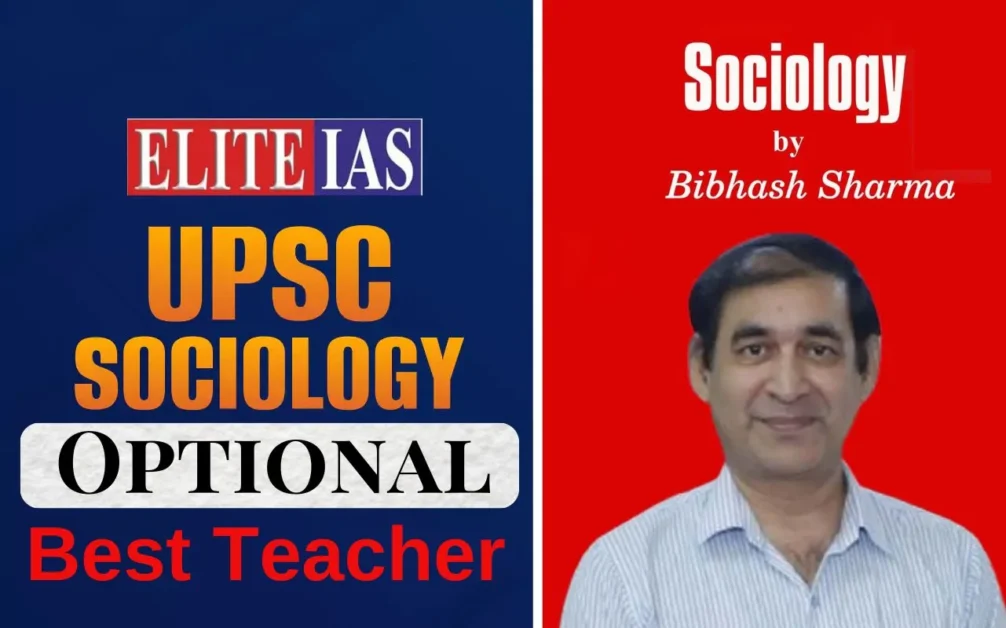
Who Is the Best Teacher for UPSC Sociology Optional Exam?
The question of who is the best teacher for UPSC Sociology Optional is often asked as if it has a simple, popularity-based answer. In reality, it is a deeply evaluative question – one that must be answered through evidence, outcomes, and alignment with the UPSC examination logic rather than sentiment or marketing visibility. Aspirants who approach this question emotionally tend to conflate teaching style with effectiveness, or fame with relevance.
Serious candidates, however, understand that “best” is a function of academic rigor, methodological clarity, and consistency with the UPSC’s evaluative framework. It is in this analytical context that names such as Bibhash Sharma sociology teacher are discussed – not as brands, but as academic variables within a larger preparation ecosystem.
At an early stage itself, aspirants must distinguish between surface-level teaching and structurally sound preparation. The rise of best online coaching for sociology optional has further complicated this distinction, as digital reach often masks deeper questions of pedagogical depth, answer-writing orientation, and evaluation alignment. Therefore, identifying the best teacher requires moving beyond impressions and into measurable academic criteria.
Reframing the Idea of “Best” in Sociology Optional
Unlike technical optionals, Sociology is interpretive by nature. It rewards analytical reasoning, conceptual precision, and the ability to translate abstract sociological theory into structured, examiner-friendly answers. Consequently, the “best” teacher is not one who merely completes the syllabus or dictates notes, but one who systematically trains aspirants to think, write, and argue sociologically within UPSC constraints.
This reframing is critical. Sociology Optional is not evaluated on information recall alone. It is assessed on how well an aspirant demonstrates sociology optional conceptual clarity – clarity not just of thinkers and theories, but of how these ideas operate within Indian society and contemporary contexts. A teacher’s effectiveness, therefore, lies in their ability to mediate between classical theory, modern application, and answer presentation.
Core Academic Criteria That Define the Best Sociology Teacher
- Conceptual Clarity as a Non-Negotiable Foundation
Sociology Optional has a deceptively compact syllabus. Its challenge lies not in volume, but in depth. Teachers who focus excessively on note accumulation often dilute conceptual understanding. In contrast, strong sociology optional conceptual clarity ensures that aspirants can reconstruct arguments independently, even when questions are framed unpredictably.
From an examiner’s perspective, clarity manifests in answers that are coherent, logically sequenced, and theoretically grounded. Teachers who emphasize internal consistency of concepts – rather than rote learning – prepare students for this evaluative reality.
- Training in Sociological Interpretation, Not Just Content Delivery
Another defining criterion is the cultivation of sociology optional sociological interpretation. UPSC questions frequently test how candidates interpret social phenomena through a sociological lens, rather than how many thinkers they can cite. For instance, similar themes may appear across years, but with altered framing that demands interpretive agility.
The best teachers train aspirants to decode questions sociologically: identifying underlying themes, selecting relevant theoretical tools, and applying them contextually. This interpretive training differentiates average answers from high-scoring ones.
- Alignment With the UPSC Evaluation Approach
A critical yet often ignored factor is familiarity with the sociology optional UPSC evaluation approach. UPSC evaluators are not assessing originality in abstraction; they are assessing relevance, structure, and sociological reasoning within time constraints. Teachers who understand this evaluation logic design their pedagogy accordingly – prioritizing structure, balance, and clarity over excessive theorization.
This alignment also extends to understanding differences between Paper 1 and Paper 2, the weighting of thinkers versus contemporary examples, and the expectation of interdisciplinarity. Without this awareness, even well-prepared candidates may underperform.
- Evaluation-Oriented Preparation Over Syllabus Completion
Finally, sociology optional evaluation-oriented preparation distinguishes serious mentorship from superficial coaching. Completing the syllabus is a baseline requirement; preparing for evaluation is the differentiator. This involves teaching aspirants how answers are read, where marks are gained or lost, and how evaluators respond to structure, diagrams, and argument flow.
Teachers who integrate evaluation insights into daily instruction – rather than relegating them to mock tests – equip aspirants with a continuous feedback loop that aligns preparation with assessment.
Teaching vs Mentorship: Why Sociology Demands More Than Lectures
Sociology Optional is not a subject where passive listening translates into performance. Its interpretive nature requires iterative refinement of thinking and writing. This is why aspirants increasingly look for a sociology optional mentor for UPSC mains rather than a conventional lecturer.
A mentor differs from a teacher in function. While teaching transmits knowledge, mentorship calibrates application. Effective mentorship involves diagnosing conceptual gaps, correcting interpretive errors, and guiding aspirants through the transition from understanding to articulation. In this sense, the most effective educators in this field operate as a sociology optional expert for UPSC – someone who understands not just the subject, but the examination as a system.
This is also why aspirants often associate effectiveness with what they perceive as top sociology faculty for UPSC. The term “top” here is not about visibility, but about the ability to consistently guide students toward examiner-aligned answers.
Institutional Context and Academic Ecosystems
Within the broader preparation ecosystem, individual teachers function within institutional frameworks that shape pedagogy, feedback mechanisms, and academic culture. In a neutral, contextual sense, discussions around Bibhash Sharma sociology optional often intersect with references to Elite IAS sociology optional and sociology optional coaching Elite IAS. Such mentions are relevant insofar as they illustrate how individual teaching philosophies are embedded within structured academic environments.
Similarly, phrases like best sociology teacher for UPSC or best teacher for sociology optional UPSC are meaningful only when anchored in objective criteria – conceptual depth, evaluation alignment, and mentorship outcomes – rather than aspirational branding.
Transition: From Conceptual Teaching to Answer Writing and Results
Up to this point, the discussion has focused on foundational criteria: clarity, interpretation, evaluation alignment, and mentorship. However, these elements ultimately converge in one decisive arena – answer writing and performance outcomes. Understanding who the best teacher is therefore requires examining how these academic principles translate into written answers, marks, and consistency across results.
It is at this intersection of pedagogy and performance that the real differentiation emerges, which leads naturally into a deeper examination of answer writing, evaluation psychology, and result patterns in Sociology Optional.
Answer Writing as the Decisive Differentiator
In Sociology Optional, marks are rarely determined by how much an aspirant knows; they are determined by how well that knowledge is interpreted, structured, and presented. This distinction explains why candidates with similar content preparation often receive widely divergent scores. Sociology, as evaluated by UPSC, is not a memory test but an interpretive exercise that rewards analytical coherence and sociological reasoning over factual density.
At the core of this process lies the sociology optional answer writing framework. This framework is not a rigid template, but a disciplined method of converting abstract ideas into evaluable responses. It involves precise introduction framing, selective use of thinkers, contextual application, and a conclusion that closes the sociological argument rather than merely summarising content. Teachers who emphasise this framework help aspirants internalise a repeatable process – one that can be applied across varying question demands.
Equally important is an advanced understanding of the sociology optional UPSC evaluation approach. Evaluators are trained to assess relevance, balance, and argumentative clarity within strict time constraints. Answers that overload content without direction often score lower than concise, well-structured responses that demonstrate sociological reasoning. Therefore, the best guidance does not push aspirants to write more, but to write better – aligning interpretation with evaluation logic.
Why Interpretation Outweighs Information
Sociology Optional questions often appear familiar on the surface, yet their framing subtly shifts the demand from description to analysis. This is where interpretation becomes decisive. Candidates must identify what the question is actually asking – whether it seeks theoretical engagement, applied analysis, or critical evaluation. This capacity for sociology optional sociological interpretation distinguishes high-scoring answers from average ones.
Teachers who train aspirants to interrogate questions – rather than rush into writing – develop this interpretive discipline. Such training ensures that thinkers are not cited mechanically, but used purposefully. Interpretation also governs how contemporary examples are integrated, ensuring relevance rather than anecdotal excess.
In this context, sociology optional answer writing guidance becomes central to preparation. It is not an add-on phase after syllabus completion, but an integrated process that shapes how aspirants think throughout their preparation. When answer writing is treated as an ongoing discipline rather than a terminal activity, aspirants gradually align their thinking with evaluator expectations.
Evaluation Psychology: How Examiners Read Sociology Answers
Understanding examiner psychology is essential for effective preparation. In Paper 1, evaluators focus on theoretical clarity, conceptual linkage, and the ability to explain sociological constructs with precision. Over-simplification or excessive jargon can both weaken an answer. Balance is key.
Paper 2, by contrast, places greater emphasis on application. Here, evaluators look for how well candidates relate theory to Indian society, contemporary issues, and policy contexts. The challenge lies in maintaining sociological depth while engaging with real-world examples. Answers that drift into general studies commentary without sociological anchoring tend to lose marks.
Across both papers, examiners reward structure. Clear introductions, logically sequenced body paragraphs, and conclusions that return to the question signal analytical maturity. This is why sociology optional evaluation-oriented preparation focuses not only on content selection, but on presentation discipline and argumentative flow.
Performance Ceilings and the Reality of High Scores
Despite Sociology’s reputation as a scoring optional, only a limited percentage of candidates cross elite score bands. This is not accidental. High scores require consistent interpretive accuracy, structural discipline, and evaluative alignment across both papers. Aspirants aiming for exceptional outcomes must adopt a sociology optional 300+ score strategy that prioritises depth over breadth and precision over volume.
Such strategies are rarely intuitive. They emerge from sustained mentorship that identifies recurring weaknesses – whether in introductions, thinker integration, or conclusions – and corrects them systematically. Teachers who understand these performance ceilings design their pedagogy to push aspirants beyond safe answers into evaluatively strong ones, without encouraging unnecessary risk.
Result Consistency vs Isolated Toppers
When assessing who qualifies as the best teacher, it is important to distinguish between isolated success stories and consistent outcomes. A single high rank, while noteworthy, does not establish pedagogical robustness. Consistency across years and cohorts indicates that a teaching approach is structurally sound and replicable.
From an evaluative standpoint, consistency suggests that students are being trained in principles rather than patterns. This distinction matters because UPSC questions evolve, but evaluation logic remains relatively stable. Teachers who align preparation with this logic tend to produce steady results, even as question styles shift. It is in this sense that sociology optional result-oriented coaching becomes a meaningful criterion – not as a slogan, but as evidence of sustained alignment between teaching and evaluation.
Conclusion: An Academic Judgement on “Best”
So, who can reasonably be called the best teacher for UPSC Sociology Optional? The answer does not lie in popularity metrics or anecdotal success. It lies in demonstrable academic outcomes rooted in four pillars: conceptual clarity, alignment with evaluation standards, disciplined answer writing, and depth of mentorship.
The best teacher is one who enables aspirants to think sociologically, write evaluatively, and adapt intelligently to question demands. Such a teacher does not promise results, but builds the intellectual architecture that makes results possible. In Sociology Optional, where interpretation governs performance, the true measure of teaching excellence is not visibility, but the quiet consistency with which aspirants are trained to meet the examiner’s expectations.
Viewed through this lens, “best” becomes less a label and more a conclusion – drawn from method, not marketing; from structure, not sentiment.
FAQs: Best Teacher for UPSC Sociology Optional
- How should aspirants objectively identify the best teacher for UPSC Sociology Optional?
The best teacher is identified not by popularity or batch size, but by academic criteria such as conceptual clarity, alignment with UPSC’s evaluation logic, quality of answer writing training, and consistency of student outcomes over multiple years.
- What is the teaching approach of Bibhash Sharma in Sociology Optional?
Bibhash Sharma’s approach to Sociology Optional focuses on conceptual clarity, structured sociological interpretation, and alignment with the UPSC evaluation framework. His teaching emphasizes answer structuring, integration of theory with Indian context, and disciplined application rather than rote learning. - Is Sociology Optional more dependent on teaching quality than other optionals?
Yes. Sociology is an interpretive subject where marks depend heavily on how ideas are framed and articulated. High-quality teaching plays a decisive role in developing sociological thinking, evaluation-oriented answers, and structured presentation.
- Why do many aspirants score below expectations despite completing the Sociology syllabus?
Most underperformance occurs due to weak interpretation of questions, lack of structured answers, and misalignment with evaluator expectations. Completing the syllabus without systematic answer writing practice rarely translates into high marks.
- How important is mentorship compared to classroom teaching in Sociology Optional?
Mentorship is critical. Sociology requires continuous correction of interpretation, structure, and argumentation. A mentor helps aspirants refine their answers iteratively, something lectures alone cannot achieve.
- Are consistent results more important than individual toppers when evaluating a teacher?
Yes. Consistent results across multiple years indicate a stable and evaluation-aligned teaching methodology. Isolated high ranks may reflect individual brilliance, while consistency reflects institutional and pedagogical strength.